
Banat Topola (German) – Töröktopolya (Hungarian) – Torontáltopolya(Hungarian) – Banatska Topola, Serbia (Official)
North Banat District – Vojvodina (the Serbian Banat)
Village Coordinator: Jacob Steigerwald
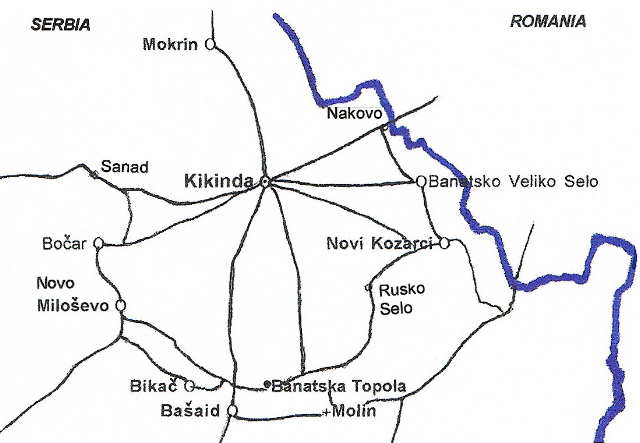
A village in the Kikinda municipality, in the North Banat District of the Republic of Serbia. It is situated in the Autonomous Province of Vojvodina. The village has a population of 1,066 of which 570 (53.47%) are ethnic Serbs and 434 (40.71%) are ethnic Hungarians. The location of the village is 18 kilometers south of the city of Kikinda. Administratively, the settlement named Vincaid is also classified as part of Banatska Topola.
Catholic Church Church name: The Ascension of Blessed Virgin Mary*
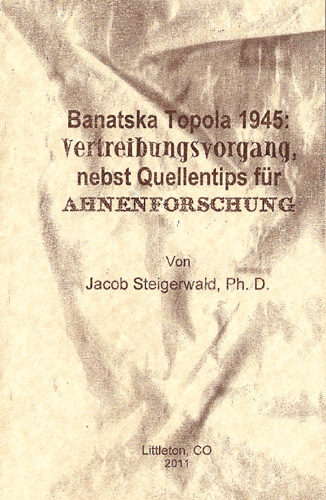
New German Book: “Banatska Topola 1945: Vertreibungsvorgang, nebst Quellentips für Ahnenforschung” – Click scroll for more information.
Banat-Topola Schwaben: 1791-1945 by Jacob Steigerwald, 1992
Finding Vital 1796-1945 Data Regarding German and Hungarian Ancestors of Banat(ska) Topola and Novo Selo, Plus an Exposé About the Local 1945-1946 Internment Camp for Germans of Yugoslavia;By Jacob Steigerwald, Ph. D. (Littleton, CO, 2009). ISBN 0-9615505-5-4.
Danube Swabian Easter Customs in Banat Topola by Jacob Steigerwald
As of 1945, the following family names were represented at Banatska Topola = Torontáltopolya = Töröktopolya and neighboring Novo Selo. (Quite a few German and some French-speaking early settlers came from Banat area villages like Heufeld, Mastort, St. Hubert, Charleville, and Soltur): Bauer, Beck, Behring, Bogner, Brenner, Dippong (DuPont), Eck, Ermler, Erndt, Escher, Fetter, Fillip (Phillip), Fuchs, Gantschier, Geisler, Gengler, Grün, Haberland, Huhn, Jäger, Jakob, Keller, Kittl, Klecker, Konrad, Kowatsch, Kubi, Lang, Leblang (LeBlanc), Lesch, Loch, Lohberger, Loran, Lutje (Luthier), Lutsch, Martin, Massong (Maçon). Mayer, Müller, Nimmersein, Paul, Peckl, Petri, Potwen, Pressler, Renji (Renier), Schödl, Schummer, Schwarz, Sendef, Simon, Springer, Steigerwald, Steinmetz, Walter, Wasza, Willar.
Last Names of local Hungarian residents included the following: Ács, Alár, Bába, Bálint, Balogh, Barna, Benyocki, Bodri, Bögre, Boros, Borsi, Borzsos, Cil(l)I, Cukrász, Dudás, Farkas, Fazékas, Fehér, Fejes, Galsik, Gyönge, Hegedüs, Horváth, Huszár, Kanász, Kardos, Kiss, Kocsis, Kurunci, Lakatos, Lengyel, Matyus, Mészáros, Molnár, Nagy, Németh, Ökrös, Rónay, Szabó, Szakál, Szánto, Szöke, Takács, Tamasi, Toth, Turi, Vajda, Varga, Veréb, Vörös, Zónai.
FOR LEADS TO RECORDS, CONSULT:
Finding Vital 1796-1945 Data Regarding German and Hungarian Ancestors of Banat(ska) Topola and Novo Selo, Plus an Exposé About the Local 1945-1946 Internment Camp for Germans of Yugoslavia.
By Jacob Steigerwald, Ph. D. (Littleton, Colorado, 2009).
ISBN 0-9615505-5-4.
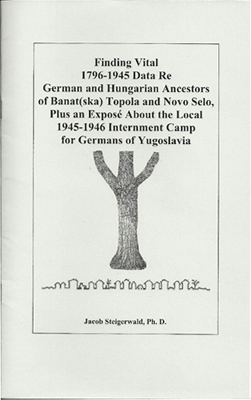
USES OF THIS BOOKLET INCLUDE:
- a) Locating vital data relating to German and Hungarian ancestors that lived at Novo Selo and/or Torontaltoplya = Töröktopolya = Banat Topola = Banatska Topola between 1796 and 1945,
- b) Finding references to area villages where ancestors used to live before they relocated to the places indicated,
- c) Discerning population growth and developmental stages of Novo Selo, Torontaltoplya =Töröktopolya = Banat Topola = Banatska Topola;
- d) References to further sources of information are provided in the Bibliography,
- e) Gaining insights concerning the unlawful internment tribulation of indigenous Germans when Marshall Tito and communist partisans came to power near the end of WWII,
- f) Learning about evil procedures employed for eliminating former Yugoslavia’s German minority, despite the fact that group members’ local presence extended back to the 18th century.
- g) Getting a better understanding about the ethnic minority known as Donauschwaben, i. e., Danube Swabians, and their primary habitats in Hungary, Romania, and former Yugoslavia.
- h) Indications regarding current whereabouts of the widely dispersed group members in different countries are found in the Preface. – An Index provided guides readers to topics touched upon.
Copies of the opus can be ordered for $3.99 each, plus $2.00 shipping (in the U.S.A.), from: Translation & Interpretation Svc. 5960 S. Estes Street, Littleton, Colorado 80123 U.S.A.
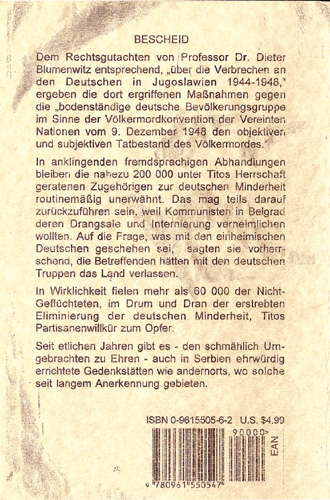
“Banatska Topola 1945: Vertreibungsvorgang, nebst Quellentips für Ahnenforschung”
[BT 1945: Expulsion process, with source tips for ancestral research] by Jacob Steigerwald, Ph. D.
Copies can be ordered for $4.99 each, plus $2.00 shipping (in the U.S.A.), from:
Translation & Interpretation Svc
5960 S. Estes Street
Littleton, Colorado 80123 U.S.A.
ISBN: O-961550505-6-2
Banat Topolas Schwaben: 1791-1945. by Jacob Steigerwald, Ph. D., Winona, Minnesota:
Translation & Interpretation Service, 1992. ISBN 0-9615505-3-8
Descendants of expelled and widely scattered former inhabitants of this village in the Vojvodina are now also living in some English-speaking countries. The listing of former local residents (p.48-51) should prove useful in genealogical research, along with the village history that is provided, from it’s founding to the expulsion of its German-speaking native population in 1945. – How this German-Hungarian Catholic settlement with the successive names of Torontáltopolya, Töröktopolya, and Banatska Topola became a place of religious veneration is also covered in this combined German and English volume. [Reviews] Bilingual paperback (Ger. & Engl.) 27.5 X 21 cm, 154 pages, $19.95, ISBN 0-9615505-3-9 Illus., with intermittent biographic content and a bibliography. (Winona, MN 1992).
Availability status:
In stock Order through bookstores or by mail from:
T & I Svc, 5960 S. Estes St., Littleton, CO 80123
Last updated: 08/08/2025